
When working on transformers running above 100kHz, skin effect and proximity effect are hard to avoid. For every new project, one of the first things I struggle with is picking between litz wire and triple insulated wire.
Litz wire is made of many fine, individually insulated copper strands twisted and transposed. The benefit is straightforward. Current spreads across all strands, cutting AC losses at high frequency. With the same copper cross-section, it runs much cooler. For high-power resonant or LLC power supplies that need stable long-run performance and good efficiency, litz wire is usually my first choice.
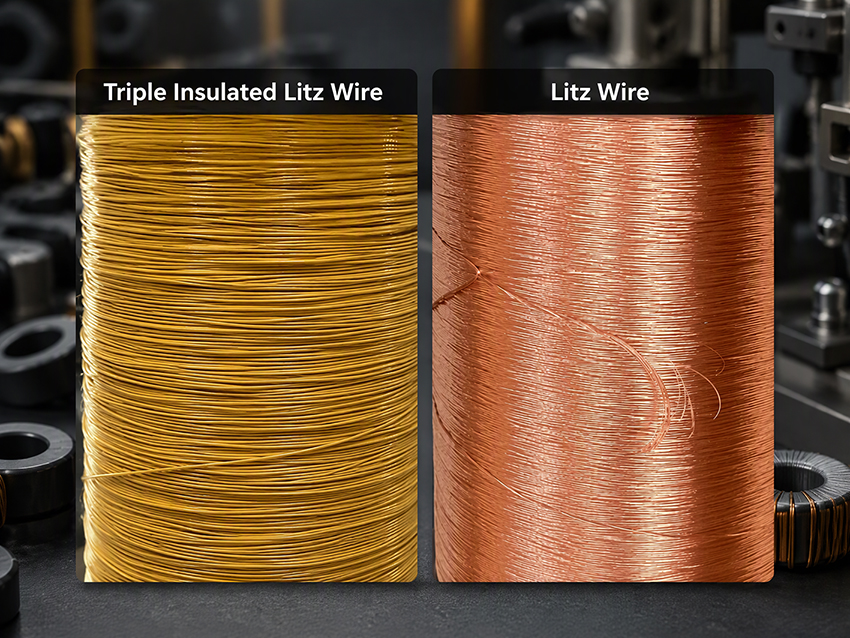
That said, it comes with quite a few headaches. It costs more. The wire is loose and tricky to wind. If winding machine settings are off, those thin strands can easily fray or break. One point many new engineers miss: litz wire has no built-in reinforced insulation. If we need isolation between primary and secondary, we still have to add insulating tape and barriers. This takes up window space and adds extra work during production.
Triple insulated wire, or TIW, makes isolation much easier. It has three extruded insulation layers that meet reinforced isolation requirements by itself. No extra tape is needed between windings. It works great on automatic winding machines, saves labour, and helps build more compact transformers. A lot of engineers prefer it for low-to-medium power flyback designs, especially medical and consumer products with strict safety rules.
Its main weakness is high-frequency loss. Most standard TIW uses a solid single copper core. Once the frequency goes over 100kHz, current only flows along the conductor surface. AC resistance rises, losses go up, and it runs hotter than litz wire. There are multi-strand TIW options out there, but their transposition cannot compare with proper litz wire. They do not help enough with loss, so they are not suitable for high-current designs where efficiency matters a lot.
The way I choose is simple, based on hard project requirements. I go for litz wire for high-power continuous operation, when thermal control and efficiency are top priorities, and there is enough window space for isolation barriers. If it is low or medium power, tight safety specs, small size and easy mass production are what we need most, and efficiency does not have to be perfect, triple insulated wire works better.
Neither wire is universally better. It all depends on which requirement is the non-negotiable bottom line for this project.
Post time: Oct-21-2026


